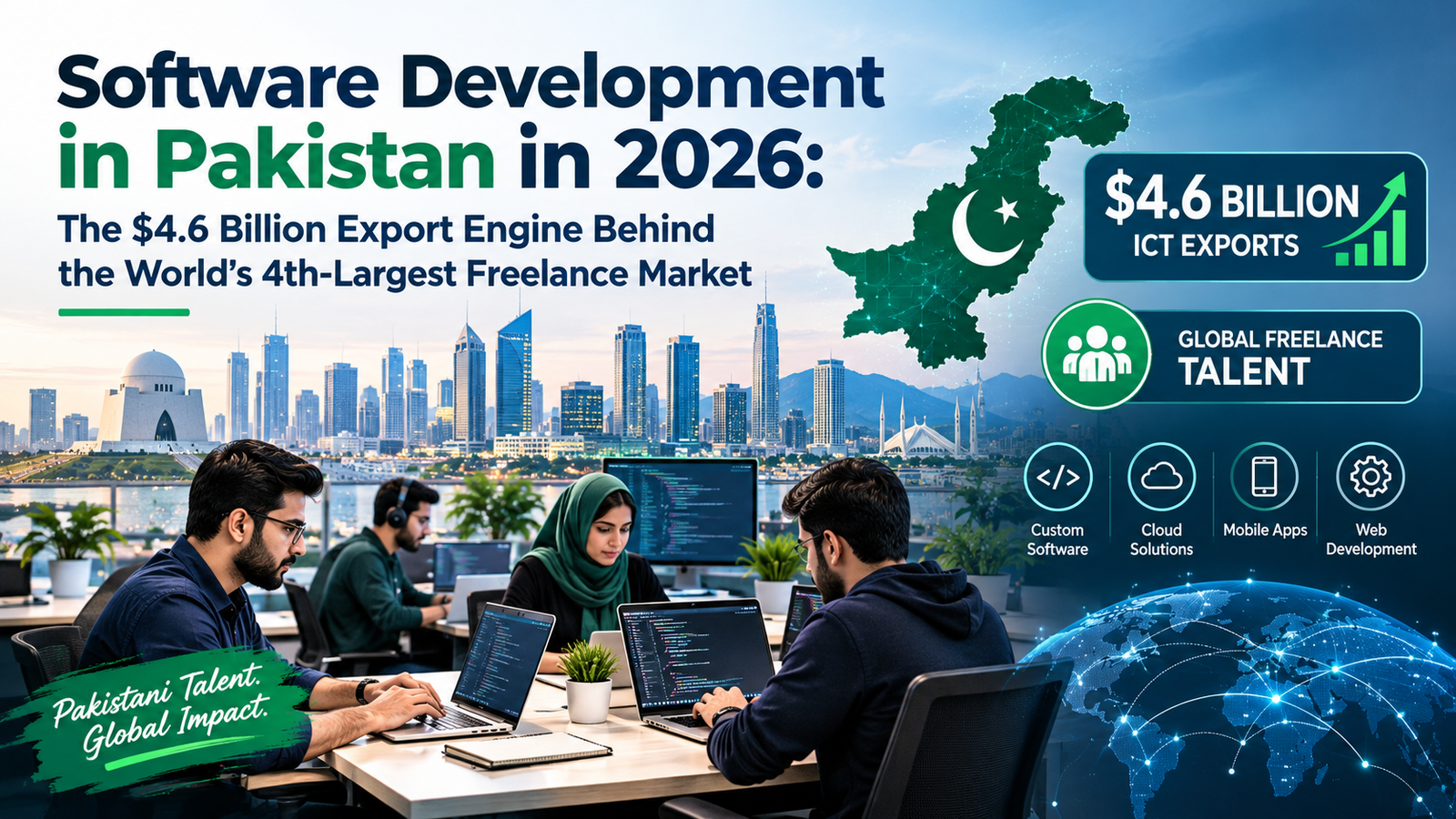
Pakistan's software industry just sold more than ever to the outside world — $4.6 billion in a single fiscal year. Behind that record sits a story most foreign buyers still do not know: a mature agency scene in Karachi, Lahore and Islamabad, a freelance force of 2.37 million, and senior-level rates that still undercut India. This is the market data, the reasons global clients keep buying, and how to buy well — written from inside a Karachi software house.
1. The number that changed the conversation
In fiscal year 2025-26, Pakistan's information technology exports reached a record $4.6 billion, up 21% from the $3.814 billion earned the year before, according to the State Bank of Pakistan's balance-of-payments data. June alone brought in $416 million — the highest monthly figure of the entire fiscal year. The sector finished strong: $1.212 billion in the April-June quarter.
Those are not vanity numbers. Technology became Pakistan's largest services export category, generating almost half of all services export revenue. Software, IT-enabled services, business process outsourcing, cloud, AI, cybersecurity and digital consulting all feed the same pipeline — and the fastest-growing slice of it is software built by Pakistani teams for clients who never set foot in the country.
2. What "software development in Pakistan" is in 2026
Ten years ago, Pakistan's software scene was mostly freelancers competing on price and a few dozen agency teams serving local banks and multinationals. The 2026 picture has three distinct layers, and it is worth knowing which one you are actually talking to.
- Software houses and studios — registered companies delivering web applications, e-commerce platforms, ERP, CRM, POS and industry-specific systems with design, development, QA and support under one roof. Karachi holds the largest concentration, with Lahore and Islamabad close behind.
- Product and SaaS startups — teams that have shipped their own products and now build for clients with product-grade discipline: roadmaps, sprints, retrospectives, CI/CD.
- Freelancers and micro-teams — 2.37 million registered freelancers spanning every skill level, from newcomers on data entry to senior engineers who left agency jobs to work direct.
The practical consequence: a buyer in 2026 can find a freelance specialist for a narrow task, a mid-size agency for a full product, or a dedicated team that behaves like an in-house department. The hard part is no longer finding talent — it is choosing the right tier and vetting it properly.
3. Inside the export engine: 46% of all services exports
Pakistan's total services exports reached $10.034 billion in FY26, and the IT category contributed nearly half of that — 46%. To put the growth in context:
| Metric (FY2025-26) | Figure | What it tells you |
|---|---|---|
| Total IT exports | $4.6 billion | Record high; +21% year on year |
| Share of services exports | ~46% | Largest services export category |
| Best month (June 2026) | $416 million | Momentum, not a one-off spike |
| Jul-May exports | $4.18 billion | $709M more than the same window in FY25 |
| Freelance earnings | Over $1 billion | First time past the billion mark, ~25% of IT exports |
Two forces drive the growth. First, currency rebalancing: the PKR's position against the dollar means foreign buyers get more engineering hours per dollar than they did in 2021, and vendors that survived the last five years now carry experienced, battle-tested teams instead of cheap juniors. Second, capability: the quality of delivered work rose across the board, which is why repeat business and referrals now power growth more than rate-shopping.
4. The freelance layer: 2.37 million people, $1B+ in earnings
The State Bank's data shows freelancer export earnings crossed $1 billion for the first time in FY26 — a 50% jump year on year — contributing about a quarter of all IT exports. With more than 2.37 million registered freelancers, Pakistan is now the world's fourth-largest freelance market, and the Pakistan Freelancers Association notes that over 99% of the skilled IT workforce is under 40, with young people in towns and villages earning foreign exchange directly.
For a business buyer, the freelance boom is a double signal. It is proof of depth: millions of developers, designers and testers competing on global platforms means the talent pipeline is wide. It is also a warning: quality varies enormously, so a freelancer with impressive profile photos and zero verifiable delivery history will cost you time and money. The same currency that makes Pakistan attractive — lower rates — is exactly why you need verifiable evidence of delivery before you commit.
5. Why foreign clients keep choosing Pakistan
Every outsourcing destination advertises itself. Pakistan's advantages are concrete and traceable to how the market actually operates:
- Real capability at lower cost. Senior rates typically run 10-15% below India's top tier, and mid-level talent is even cheaper. In 2026 the capability gap to Tier-2 Indian product studios has effectively closed on most project types.
- English fluency. Software delivery runs on written communication — specs, tickets, code reviews. Pakistani senior developers work in English natively and are comfortable with logistics, accounting and supply-chain jargon because those domains are core local industries.
- Time-zone overlap. Karachi shares roughly 4 hours of working time with US East Coast and 5 hours with the UK — better than most of South Asia. For European and Gulf clients the overlap is effectively a full day.
- Export discipline. Because so much revenue comes from foreign clients, reputable firms run on international norms: NDAs, IP assignments, hourly or milestone billing, Slack, Jira, Git.
- Gulf proximity. Dubai and the wider Gulf are a short flight away, so nearshore-style collaboration — site visits, workshops — is practical for clients who want it.
6. Pakistan vs India vs Philippines: one honest table
You will read plenty of one-sided comparisons. Here is a balanced one drawn from working rates and delivery patterns in 2026:
| Factor | Pakistan | India | Philippines |
|---|---|---|---|
| Senior developer rate (USD/hr) | $45–$75 | $50–$100 | $35–$65 |
| English fluency (tech delivery) | Strong | Strong | Strong (US-centric accent) |
| Overlap with US East | ~4 hours | ~3.5 hours | ~8 hours |
| Overlap with UK | ~5 hours | ~4.5 hours | Little (no overlap) |
| Mature agency ecosystem | Growing fast | Very mature | Mature (BPO-heavy) |
| Currency stability | PKR more volatile | INR more stable | PHP moderate |
| Best fit | Custom software, web apps, ERP/CRM, dedicated teams | Enterprise scale, huge teams, legacy migration | Support, BPO, customer ops, QA |
The honest summary: India wins on sheer scale for enterprise programmes, the Philippines wins on support-style work and real-time overlap, and Pakistan wins on value-per-hour for custom software products — the exact segment most mid-size companies need.
7. What Pakistani teams actually build best
The export data groups everything under "IT services," but the project types that dominate real portfolios in Karachi and Lahore are specific:
- Web applications and SaaS products — dashboards, portals, multi-tenant platforms with modern stacks.
- E-commerce stores — including the payment-heavy reality of Pakistani retail: e-commerce development that integrates Raast, wallets and COD flow.
- ERP, CRM and management systems — inventory, accounts, HR, school, pharmacy and transport systems — the bread and butter of custom software development in Karachi.
- API and payment integrations — API integration work connecting stores, banks, logistics and SaaS tools.
- AI and cloud solutions — the AI wave reached Pakistan's vendors early; the export data specifically credits cloud, AI and cybersecurity services in the record year.
- BPO and call centres — a major earning line in their own right, now increasingly AI-assisted.
If your project fits one of these, the local ecosystem has deep, export-proven reference cases. If it is exotic — niche hardware, regulated fintech at enterprise scale — the pool of qualified teams is smaller, and vetting matters even more.
8. Who is buying: the US, the UK, the Gulf — and now APAC
Historically, US and European buyers dominated Pakistan's IT order books. The 2025-26 data shows the base widening: Pakistani small and mid-size exporters are actively expanding into Asia-Pacific hubs, and Gulf demand keeps rising because of proximity and shared business culture. The pattern inside a Karachi agency today:
- US founders — web apps, MVPs and maintenance for startups and SMEs; they value the 4-hour overlap and the rates.
- UK and EU companies — longer engagements, often dedicated teams for product development.
- Gulf businesses — custom management systems, e-commerce, integrations; close travel and same-day communication.
- APAC and beyond — the fastest-growing new demand, per Pakistan's 2026 digital-economy reports.
The mix matters to you as a buyer: a vendor with Gulf and UK clients behaves differently from one whose whole book is US gigs. Ask for reference clients in your region and your industry — export-tested teams have them.
9. What this boom means if you are buying software
Here is the part most market write-ups skip: the growth is good news for buyers, but only if you stay disciplined.
The discipline part: don't hire on rate alone. The market's biggest failure mode is a buyer choosing the cheapest proposal and then paying twice in rework. Price your project across two or three vendors, but weight delivery evidence — portfolios, GitHub activity, case studies, reference calls — at least as heavily as the quote.
And remember the ecosystem is horizontal: the same pool that builds your custom web application can maintain it, extend it, and integrate it with everything else you run. Long-term support capacity is a real advantage of agency work over one-off freelancing.
10. How to work with a software development company in Pakistan
A repeatable vetting process, in the order we would run it ourselves:
- Define the deliverable in writing first. Scope, success criteria, and what is explicitly out of scope. A clear brief separates good vendors from good salesmen.
- Check delivery evidence, not logos. Live products, code quality on GitHub/GitLab, client references you can call. Ask what the vendor built for the client on the reference call, not what the client's brand is.
- Ask about process. How do they run sprints? Where do they track work? How do they demo progress? Vague answers ("we just build fast") are a warning sign.
- Talk to the actual team, not only the account manager. The developer who will write your code should explain how they would approach your project.
- Structure payment to milestones. Spread payments across demonstrable milestones with an exit clause. Export-disciplined firms expect this.
- Agree on IP and security up front. NDA, IP assignment, code repo under your account, 2FA, and data handling — signed before a single line is written.
For rate benchmarks, team models and the full “freelancer vs software house” breakdown, our companion guide — Software Development in Pakistan 2026: Real Hourly Rates & How to Hire — goes deeper into pricing and contracts.
11. The risks — and how to manage them
Honest market coverage includes the downside. The main risks with software development in Pakistan, and the controls:
- Quality variance. The freelance market spans genius to disaster. Control: verify delivery evidence; start with a paid pilot sprint before committing to a full build.
- IP leakage or re-use. Reputable firms sign NDAs and honor them; fly-by-night operators copy code. Control: written IP assignment, repo ownership, and re-use clauses in the contract.
- Communication gaps. English is strong at senior levels, but written specs still get misinterpreted. Control: over-document; weekly demo calls; keep decisions in writing.
- Retention risk on dedicated teams. Developers can leave mid-project. Control: ask about backup and knowledge-transfer plans; avoid single-point-of-failure staffing.
- Currency and payment friction. Cross-border payments occasionally hit banking delays. Control: agree on payment rails (wire, Wise, Payoneer, crypto where suitable) before the engagement starts.
None of these is unique to Pakistan — they are standard outsourcing risks everywhere. What differs is that the market's growth means most experienced firms have already solved them for earlier foreign clients, so you are not pioneering; you are picking.
12. Frequently asked questions
Q1. Is software development in Pakistan good quality?
Yes, for most project types. Pakistan's IT sector exported a record $4.6 billion in fiscal year 2025-26, and the freelance workforce of 2.37 million is the world's fourth largest. Clients from the US, UK, Europe and the Gulf consistently buy web applications, e-commerce platforms, ERP, CRM and custom management systems from Pakistani teams, and senior developers work in English with a 4-5 hour overlap with Western time zones.
Q2. How much does software development in Pakistan cost compared to India?
Senior developer rates in Pakistan typically run 10-15% below India's top tier, with mid-level talent even cheaper. Total cost of ownership also depends on communication discipline, retention and rework cycles, so the hourly rate is only part of the picture. In 2026 Pakistani teams deliver at a level closer to Tier-2 Indian product studios than to the freelance-only market of five years ago.
Q3. How big is Pakistan's software and IT industry?
Technology exports reached a record $4.6 billion in FY25-26, up 21% year on year and nearly 46% of the country's total services exports. Freelancers contributed more than $1 billion — about 25% — and more than 2.37 million registered freelancers make Pakistan the world's fourth-largest freelance market.
Q4. Should I hire a freelancer or a software development company in Pakistan?
For a small, well-defined task with clear handoff, an experienced freelancer can work well. For a product, an e-commerce store, or a system that needs design, backend, testing and long-term support, a software house gives you process, accountability and continuity. Many Pakistani agencies also offer dedicated teams that act like an extension of your own engineering department.
Q5. What types of software do Pakistani companies build best?
Web applications and SaaS products, e-commerce stores, ERP and CRM systems, POS and inventory software, school and pharmacy management systems, API and payment gateway integrations, and increasingly AI and cloud-based solutions. Karachi, Lahore and Islamabad hold the largest concentration of software houses.
Q6. How do I protect my code and data when outsourcing to Pakistan?
Use a written contract with an NDA and explicit IP assignment, keep code in a repository you own, enforce two-factor access control, and ask about the vendor's data handling. Reputable software houses expect these requirements and sign them without resistance — treat pushback on IP terms as a red flag.
13. Conclusion: the window is still open
Pakistan's software industry crossed $4.6 billion in exports because it built something real: an export-tested, English-fluent, cost-competitive engineering base with 2.37 million freelancers and a maturing agency scene behind it. The 2026 numbers are not a prediction — they are reported results.
For a buyer, the practical takeaway is simple. The talent is deep, the rates are favorable, and the reference cases are export-proven. What separates a good outcome from a horror story is vetting: written scope, verified delivery evidence, milestone payments, IP protection, and a team you have actually talked to. Get those right and you are buying from one of the world's most active software export markets at a price that still turns heads.
Planning software development in Pakistan? Start with a team that ships.
Global Dezigns is a Karachi-based software development and web agency building web applications, e-commerce platforms, ERP/CRM systems and integrations for clients at home and abroad. We work on clear milestones, sign proper IP and NDA terms, and show you progress every week.
Sources and further reading
- State Bank of Pakistan — official website
- The Express Tribune — IT exports hit record $4.6 billion (FY26 SBP data)
- The Express Tribune — IT exports pass $4.18B in July-May, freelancers cross $1B
- Digital Pakistan — $4.5B+ IT exports in FY26, expansion beyond the US
- Pakistan Software Export Board (PSEB)
