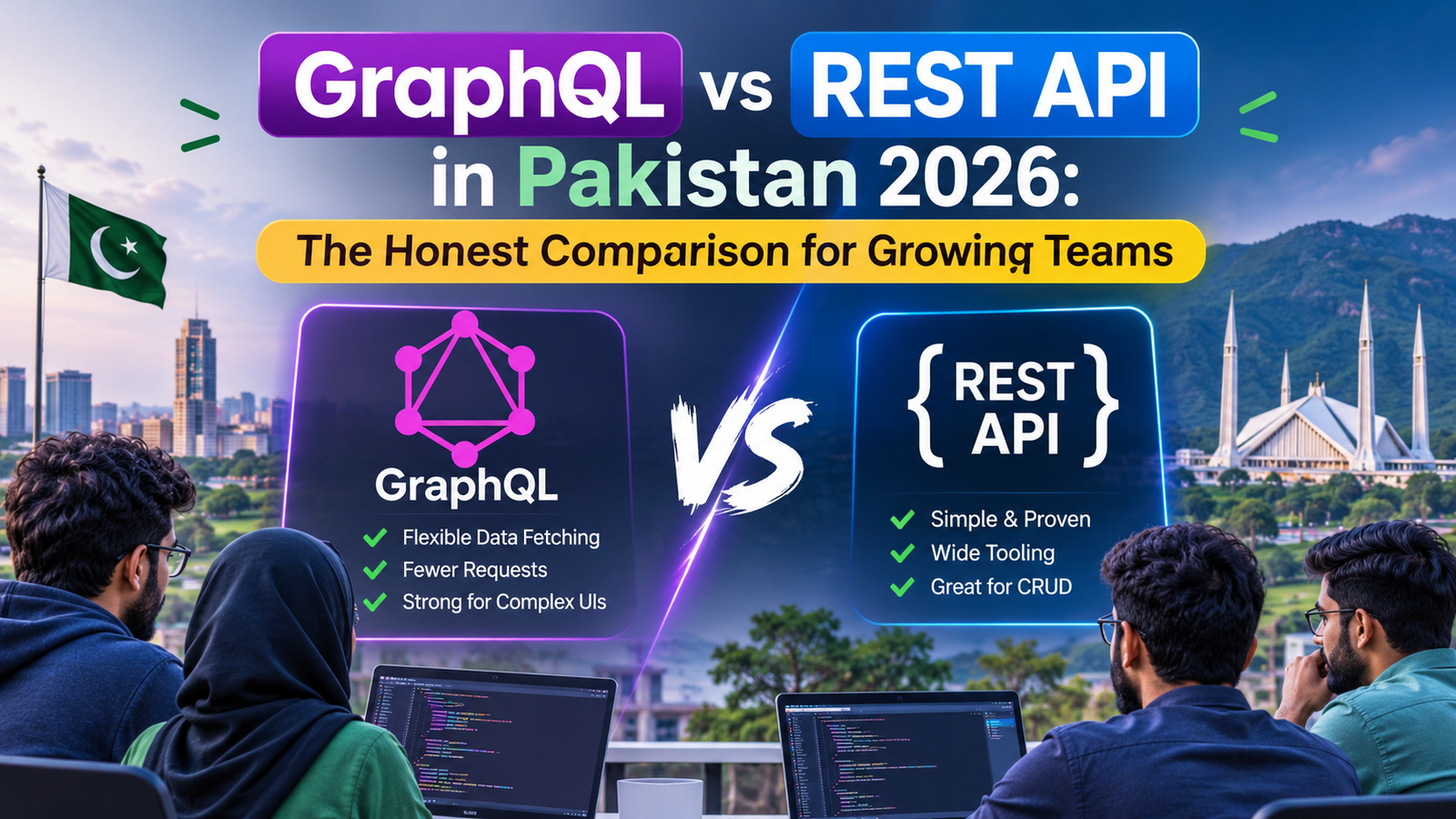
GraphQL is usually presented as the modern replacement for REST. In practice it is a different tool with a different cost profile. This guide explains where each one fits, the four operating costs that decide most projects, and the security limits a GraphQL API needs before it goes live.
1. Why the API style is a business decision
Every website, store or internal tool eventually has an API behind it. Mobile apps call it, partner systems call it, and the front end calls it on every page load. Choosing how that API is shaped is not a developer preference. It decides how quickly features ship, what the mobile experience costs in data, and how much work a future integration will require.
The GraphQL Foundation makes an important point in its best-practices material: the specification is intentionally silent on networking, authorization and pagination, because those are outside what GraphQL defines. That is a useful warning. Those are the parts of an API that decide whether it survives real traffic, and they are the parts a tutorial rarely covers.
For a business in Karachi or anywhere in Pakistan, the practical question is narrow: does the current REST approach create a cost you can actually measure? A request waterfall on a slow mobile connection, a front-end team blocked waiting for new endpoints, or a partner integration that keeps needing custom aggregation routes. If none of those apply, the GraphQL argument is theoretical.
2. The one difference that explains everything
REST structures communication around resources. Each resource has a URL, standard HTTP verbs map to operations, and the response shape is defined by the endpoint. A client that needs more data makes another request, which is where request waterfalls appear.
GraphQL inverts that control. There is one endpoint, and the client specifies the fields it needs. The server returns exactly those fields and nothing else. The GraphQL Foundation describes this directly: a typical REST API requires loading from multiple URLs, while a GraphQL API gets the data an app needs in a single request.
That difference explains both sides of the debate. Fewer round trips and less wasted data are real advantages. The server also has less freedom: it must run whatever shape the client asked for, which is where the operational costs appear.
Both approaches have a contract. REST documents endpoints with a specification such as OpenAPI, which can drift from the implementation. GraphQL uses a typed schema that documents itself, generates client types and validates queries, which is why teams often find it easier to keep a front end and a back end aligned.
3. Where REST is still the right answer
REST remains the default for a large share of real work, and choosing it is not choosing to be behind. It is choosing the option with less operational surface.
- Public and partner APIs. Every HTTP client in every language can consume REST, so integration friction is lowest.
- Simple CRUD over a handful of resources. This describes most business software, and an extra query layer adds nothing.
- When HTTP caching matters. Each resource has a URL, so browsers, proxies and CDNs can cache responses with standard headers and no extra infrastructure.
- File uploads, downloads, streaming and webhooks. Here the HTTP semantics are the feature rather than the wrapper.
- Serverless deployment. Stateless request handling is exactly what function platforms bill well for.
If a Pakistani business needs a fast, dependable API integration that connects an order system, a courier partner and a payment gateway, REST with a clear specification is usually the cheapest correct answer. It is also the easiest to hand to a maintenance team later.
4. Where GraphQL earns its cost
GraphQL is genuinely strong in a narrower set of situations, and when it fits, the gain is real rather than cosmetic.
- Several clients with different needs. A web dashboard, a mobile app and a partner feed reading the same data in different shapes is the classic GraphQL case.
- Deeply nested relationships. A customer, their orders, each order's items and each item's supplier turns into a request waterfall in REST.
- Bandwidth-constrained users. Requesting only the needed fields measurably reduces transferred data, which matters on mobile data plans.
- Front end and back end moving at different speeds. A typed schema lets a front-end team compose new views without waiting for a new endpoint on every change.
- Consolidating several services. One schema in front of multiple back-end services gives clients a single contract.
It also helps to know what GraphQL does not replace. Authentication is not special in GraphQL, the Foundation notes that OAuth or JWT patterns work as they do elsewhere. If the underlying data is not modelled as a graph, a query language will not make it one.
5. Four costs that decide most projects
The trade-off is not free flexibility versus rigid simplicity. GraphQL moves real work from the client to the server team, and four specific costs are where projects tend to stall. Knowing them in advance is the difference between a manageable migration and a rewrite.
1. Caching moves from free to owned
REST endpoints have URLs, so standard HTTP caching works without extra work. A GraphQL request is typically a POST to one endpoint with the query in the body, which standard HTTP caching does not handle. A team that moves to GraphQL is now responsible for its own caching layer, such as persisted queries or a normalised client cache.
2. The N+1 query problem
If a resolver runs a database query for every item in a list, one client request turns into hundreds of database requests. The fix is batching in the data layer so the lookups collapse into one batched request. The OWASP GraphQL Cheat Sheet names server-side batching and caching as a general performance practice for this reason. The trap is that batching only works if every resolver author remembers to use it.
3. Authorization becomes per-field
REST protects a route with middleware. GraphQL has one route and many fields, so a check that protects one endpoint says nothing about the next field. The GraphQL Foundation's guidance is clear: delegate authorization logic to the business logic layer, so there is a single source of truth. It also recommends passing a fully hydrated user object into that layer rather than an opaque token, so the rule can be applied consistently.
4. Rate limiting stops being per-request
One request can be arbitrarily expensive if it nests deeply or asks for very large lists. A limit of requests per second no longer describes the cost. Limiting has to move towards query cost, and the GraphQL Foundation's own FAQ lists throttling based on server time as one of the recommended approaches.
A team of three shipping a standard business product should not spend a quarter building this capability. A team with several clients, a large schema and measured mobile bandwidth problems probably already needs it.
6. GraphQL security limits before launch
A GraphQL endpoint accepts a query shape from the client, which creates exposure that a REST route does not have. The OWASP GraphQL Cheat Sheet documents these risks and the mitigations, and they belong in the scope of any web application build that uses GraphQL.
| Risk | What the attacker does | What to implement |
|---|---|---|
| Excessive query depth | Nests relations many levels deep so resolution work explodes | A maximum depth limit; the cheat sheet notes this is not natively supported and needs custom work or a library instrumentation |
| Excessive requested amount | Asks for a very large number of objects in one field | An amount or input-number limit, plus pagination on any large list |
| Long-running queries | Sends queries that keep the server and database busy | Timeouts and query cost analysis, applied at the application level where the work can be stopped |
| Batching attacks | Crams many queries or object requests into a single call to enumerate records or brute force values | Request limits, cost analysis, rate limiting and monitoring, since a single call can bypass network-level tooling |
| Object-level access failure | Requests an object by a guessed ID, assuming knowledge of the ID grants access | Verify the caller's access for every object, in the business logic layer |
| Schema exposure | Reads the full schema to map the attack surface | Restrict or disable introspection for unauthenticated public consumers, and consider disabling field-name hints |
Two details are easy to miss. First, timeouts alone are not a complete defence, because they may not fire until a malicious query has already consumed excessive resources. Second, disabling introspection is not a complete answer either, since field names can still be guessed, and GraphQL may return a hint when a requested field name is close to a real one.
7. Pagination and schema evolution
Two GraphQL design questions come up in almost every review, and both have clear guidance in the official best-practices material.
Pagination
The GraphQL Foundation's recommendation is direct: list fields that may return a lot of data should be paginated, and cursor-based pagination provides a stable model. The Relay project publishes a formal connection specification, so there is a documented pattern to follow whether or not the client uses Relay. Offset-based pagination is possible but can skip or repeat records when the underlying data changes between requests, which matters for an order list or a live catalogue.
Schema evolution instead of versions
The Foundation's FAQ states plainly that GraphQL avoids versioning by design, because a query only returns data it explicitly requests. That means new features, types and fields can usually be added without a breaking change for existing queries. A service can still be versioned like any REST API if the team chooses to, but the usual reason for a version bump largely disappears.
That flexibility is a real advantage, but it needs governance. Without ownership and a review process, schemas drift into an API nobody can safely change. The Foundation's schema governance material recommends automated validation in the continuous integration pipeline for every proposed change, rather than relying on review alone.
8. Running REST and GraphQL together
The most common production arrangement in 2026 is not a replacement. It is a layering, because the two styles solve different problems that happen to share the same transport.
- Public and partner contracts stay REST. Webhooks, file uploads and third-party integrations keep the universal tooling and HTTP semantics.
- Internal services keep stable interfaces. They serve other internal tools and are not reshaped for one front end.
- A single GraphQL layer sits in front for web and mobile clients. It composes data from those services and returns the shape each client needs.
- Mobile bandwidth stays a product concern. Each client requests only what its screen needs, and a small app does not pay for a dashboard's full data set.
This pattern also gives a safe migration route. The GraphQL layer can call the existing service interfaces, so a team can add client-facing flexibility without rewriting the back end or breaking integrations that already work. It adds a layer, so it should only be introduced when the client-facing problem justifies it.
9. A decision matrix you can use
Use this as a starting point rather than a rule. The deciding factor should always be a measured problem in your own product.
| Situation | Recommended starting point | Why |
|---|---|---|
| Brochure website or small business site | No public API, or simple REST | No client needs to compose queries; extra layers add cost only |
| Standard online store catalogue | REST with a documented specification | Resources are clear, caching matters, and third parties may integrate |
| Mobile app plus web dashboard on one back end | Consider a GraphQL layer over existing services | Different clients need different shapes from the same data |
| Partner or public API for external developers | REST | Lowest adoption friction and universal client support |
| Deeply nested domain data with a request waterfall | GraphQL for the client-facing layer | One request can traverse the relationships the screen needs |
| Webhooks, uploads and downloads | REST | HTTP semantics are the feature here |
| Uncertain, or a small team | Start with REST, measure, then revisit | Evidence beats a trend, and REST stays easy to hand over |
When you do need help designing an API for a website, store or internal system, Global Dezigns can scope it as part of custom software development or a website development engagement, with the security limits included in the scope rather than added later.
10. Frequently asked questions
Q1. Is GraphQL better than REST in 2026?
Neither is better in general. REST is the right default for public APIs, simple CRUD and situations where HTTP caching and universal tooling matter. GraphQL earns its cost when several clients need different data shapes from the same backend, when data is deeply nested, or when a front-end team needs to iterate without waiting for new back-end endpoints. Mature systems commonly run both.
Q2. What is the N+1 problem in GraphQL?
N+1 happens when a resolver for each item in a list triggers its own database request, so one client query becomes many database queries. The standard fix is request batching in the data layer, so the lookups collapse into a single batched request instead of one per row.
Q3. How do you secure a GraphQL API?
Verify every object a caller requests instead of assuming knowledge of an ID grants access, enforce authorization in the business logic layer as a single source of truth, set limits on query depth and requested amount, add timeouts and cost analysis, handle batching abuse, and control introspection on public endpoints.
Q4. Should a small business in Pakistan use GraphQL?
Usually not as the first choice. A small site, a standard catalogue or a brochure website does not need a single query endpoint and a schema governance process. Add GraphQL when you have real evidence of a problem REST cannot solve, such as several clients requesting different shapes or a request waterfall that hurts mobile performance.
Q5. Does GraphQL replace API versioning?
GraphQL avoids versioning by design rather than by ban. Because a query only returns the data it explicitly requests, new features, types and fields can usually be added without a breaking change for existing queries. A service can still be versioned like any REST API if the team chooses to do that.
Q6. How should I paginate a GraphQL list field?
Paginate any list field that can return a large amount of data, and use cursor-based pagination for a stable model. The Relay project publishes a formal connection specification that gives a consistent pattern to follow, whether or not the client uses Relay.
Q7. Can I run REST and GraphQL together?
Yes, and this is a common production pattern. Internal services can keep stable REST or gRPC interfaces while a single GraphQL layer sits in front for web and mobile clients, and REST remains the public contract for partners, webhooks and file uploads.
11. Conclusion: pick the boring answer first
GraphQL is a genuinely useful tool, and the case for it is strongest exactly where REST starts to hurt: many clients, deeply nested data, and a front end that needs to move without waiting on the back end. It also carries costs that are invisible in a demo and expensive in production, mainly caching, N+1 queries, per-field authorization and query-cost rate limiting.
Start with the answer that solves a measured problem. Build REST interfaces that are documented, cached where it helps, and easy to hand over. Add a GraphQL layer for clients when the request shape genuinely needs it, and include depth limits, amount limits, object-level authorization checks and a schema review process in the scope from day one.
Sources and further reading
- GraphQL Foundation — Best Practices
- GraphQL Foundation — Authorization
- GraphQL Foundation — Pagination
- GraphQL Foundation — Frequently Asked Questions
- OWASP — GraphQL Cheat Sheet
