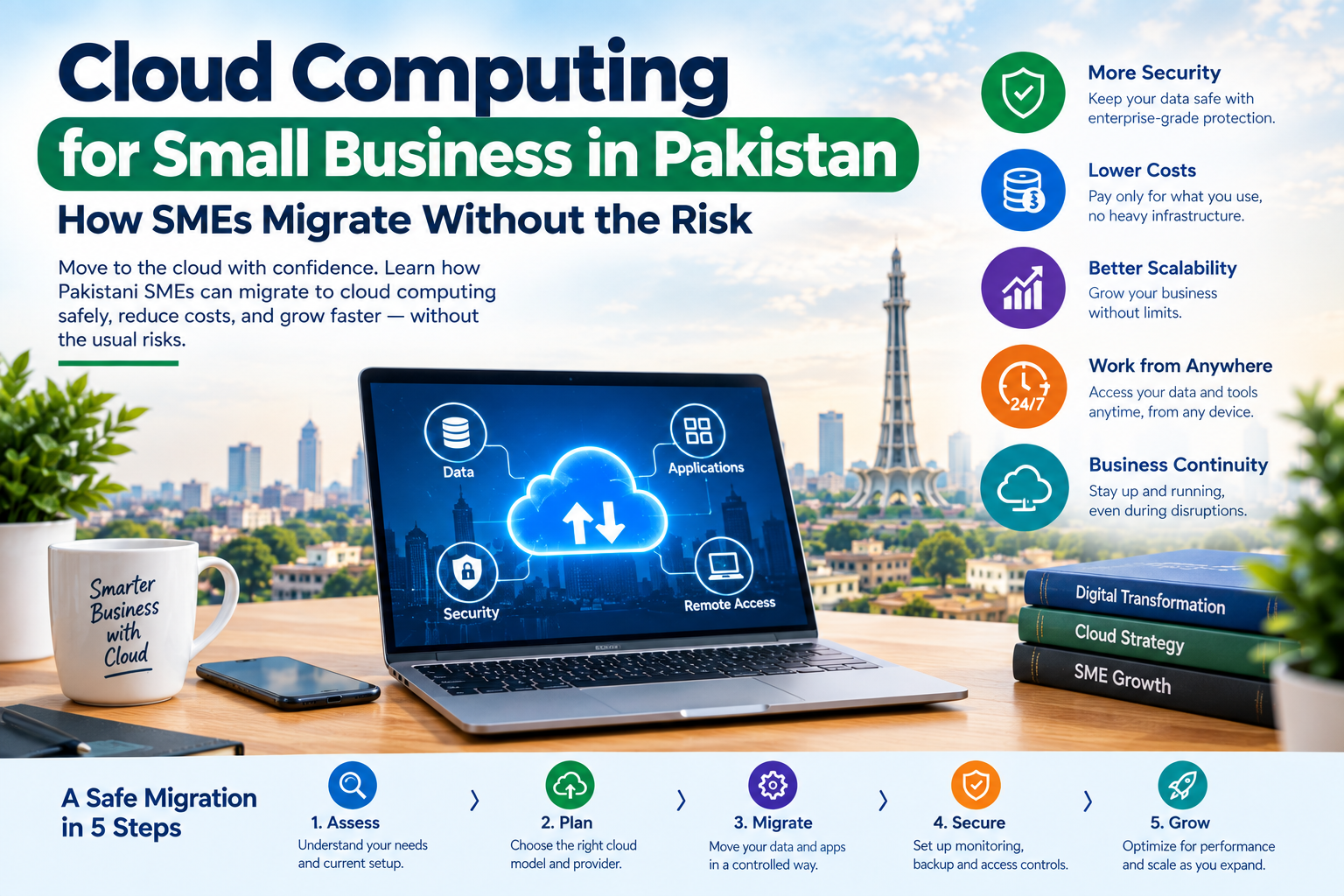
1. Why Cloud Is No Longer a Luxury for Pakistani SMEs
Ten years ago, moving your business software to the cloud felt like a decision only big banks and telcos made. Today the equation has flipped. A small trading company in Karachi, a clinic in Lahore, or a restaurant in Islamabad now runs on the same technology powering global giants — without buying a single server.
Cloud computing simply means renting computing power, storage and software over the internet instead of owning them on a machine in your office. You pay for what you use, scale up when you need more, and never worry about the hard drive dying on a Monday morning. The economics are documented well beyond marketing hype — firms like McKinsey and the State Bank of Pakistan (whose Raast and digital-payment push is quietly encouraging more online operations) both point the same direction: the barrier to modern infrastructure is falling every year.
For a Pakistani SME the question is no longer "should we move to the cloud?" but "how do we move safely, without downtime, data loss or runaway costs?" This guide answers that second question in plain language.
2. The Cloud Problems That Hit Pakistani Businesses First
Before recommending a migration, it is worth naming the real pains a local business feels every week when it stays on an old office server:
- Power and load-shedding. When the electricity drops in the middle of a sale, the office server goes down with it. Cloud data centres run on backup power you never have to think about.
- Hardware that costs and dies. A decent office server costs lakhs, needs replacement every few years, and eventually fails at the worst possible moment — usually during a month-end report.
- One person knows everything. If your "IT guy" leaves, your data and backups often leave with him. Cloud keeps systems, access and backups outside any single employee's head.
- Remote access is painful. A branch in another city or an owner travelling abroad cannot easily reach an on-premise server without complex VPN setup. Cloud works from any device, anywhere.
- No disaster recovery. A fire, flood or theft in the office can wipe out years of invoices, inventory and customer records. Cloud replication survives all of that.
- Scaling is slow. Buying and installing a bigger server takes weeks. Adding cloud capacity takes minutes.
Every one of these is a real, weekly, rupee-level problem — and all of them are solved by the same architecture shift.
3. 7 Practical Benefits a Pakistani SME Actually Feels
💸 1. No Big Upfront Hardware Bill
Instead of spending Rs 400,000+ on a server, UPS and backup drives, you pay a small predictable monthly fee. That capital can go to stock, marketing or salaries instead of depreciating hardware.
🔌 2. Load-Shedding-Proof Uptime
Cloud data centres run on redundant power with generator and battery backup. When your street goes dark, your online store, WhatsApp order flow and accounting system stay up. For a business that sells online after 9pm, this is not a nicety — it is revenue.
🌍 3. Work From Anywhere, On Any Device
Your accountant in one city, your warehouse manager in another and you on a trip abroad all see the same live data. This is the same convenience that powers remote work and the fast, responsive websites customers now expect.
🔐 4. Automatic Backups & Disaster Recovery
Cloud platforms snapshot your data continuously and can restore it in minutes. That single feature converts a catastrophic "we lost everything" into an afternoon inconvenience. For businesses that do not want to think about it, a managed provider handles this silently.
⚡ 5. Scale for Rush Season in Minutes
Eid, Ramadan and winter sales create sudden traffic spikes. On your own server you either overpay for idle capacity all year or crash exactly when demand peaks. The cloud scales up for the rush and back down after — you only pay for what you actually use. Our AI ecommerce guide shows how demand forecasting pairs with this elasticity.
🛡️ 6. Better Security Without a Security Team
Cloud providers invest heavily in encryption, firewalls and monitoring — security most SMEs could never afford alone. Data is encrypted in transit and at rest, access is role-based, and breaches are far harder than on an office PC that everyone shares the password to.
🤝 7. Always-Current Software
Updates, patches and new features roll out automatically in the cloud. You stop running outdated versions that are slow, insecure and missing features competitors already have.
💡 Start-up frame: you do not need to move everything at once. Most Global Dezigns clients migrate their most painful system first — accounting, inventory or their storefront — prove it works for a month, then move the rest. A staged migration keeps risk low and momentum high.
4. On-Premise Server vs. Cloud – Side by Side
| Business Concern | Office Server | Cloud Setup |
|---|---|---|
| Upfront cost | Rs 400,000+ in hardware | Small monthly fee |
| Power cut | Whole business offline | Data centre backup power |
| Remote access | Complex VPN, single location | Any device, anywhere |
| Backups | Manual, easily forgotten | Automatic, minute-level |
| Scaling for rush | Weeks to buy & install | Minutes to add capacity |
| Hardware failure | Downtime + repair costs | No local hardware to fail |
| Security | Depends on one shared PC | Enterprise encryption & monitoring |
| Software updates | Manual, often skipped | Automatic, always current |
5. A Safe 5-Step Migration Plan on a Local Budget
- Inventory what you actually run. List every system — accounting, inventory, POS, website, email — and who depends on it. Do not migrate a system you barely use; retire it first. If your inventory tracking is weak, our AI inventory management guide is a good read before you move.
- Start with the least risky, highest pain system. Begin with email or file storage, or a single workflow like invoicing. Prove the cloud works for your team before touching critical systems.
- Choose a provider with local relevance. Global providers (AWS, Google Cloud, Azure) are powerful, but for many SMEs a well-managed local or regional partner — who speaks your language, bills in rupees and has local support hours — is easier and more predictable. Cost alone is not the whole story.
- Plan the data move, not just the software. Set the migration window for low traffic (usually late night), validate every record after the move, and keep the old system running for a week as a fallback. Do not delete the old server until the new one has worked for a full business cycle.
- Put a managed partner on it. A reputable developer handles the whole move, configures security and backups, and stays on call. For a business whose owner is not technical, this removes 90% of the risk and all of the stress.
Looking for that partner? Global Dezigns provides custom software development in Karachi and Pakistan and can migrate, host and maintain your systems under one roof.
6. What It Really Costs in Rupees
Honest ranges depend on data size and usage, but a practical picture for a small Pakistani business:
- Shared cloud hosting (a website or small app): roughly Rs 1,000–5,000 per month — less than a single staff lunch, and far cheaper than maintaining a VPS.
- Managed business apps (accounting, inventory, CRM): typically Rs 5,000–30,000 per month depending on users and modules.
- Full migration + setup by a development partner: a one-time fee in the low-to-mid six figures for a small business, which usually pays for itself by replacing a server purchase, IT salary or both within the first year.
- What you stop paying: hardware purchase, UPS batteries, repair calls, manual backup labor, and the revenue lost to downtime.
The honest headline: for most SMEs the cloud is not a new cost — it is a way to make an existing cost smaller, predictable and failure-proof. Pairing this with modern digital payment tools from the State Bank of Pakistan and faster checkout (covered in our digital payments guide) closes the loop between online sales and instant cash flow.
7. Frequently Asked Questions
Q1: Is the cloud safe for my customer and financial data?
Yes — usually safer than an office server. Cloud providers encrypt data in transit and at rest, control access by role, and replicate backups across locations. The real risk is weak passwords and shared accounts, so enforce two-factor login and give each employee only the access they need.
Q2: Do I have to move everything at once?
No. A staged migration is the recommended path: start with email, files or one workflow, run it in parallel with the old system for a week, then move the next system. This keeps risk low and your team comfortable with the change.
Q3: Will load-shedding still take my business offline?
Not the cloud part. Cloud data centres run on redundant battery and generator power, so your hosted software, website and online ordering stay up even during a power cut. You only need power for your own devices, which a small UPS covers.
Q4: What if my internet connection is slow or drops?
Cloud systems need a stable connection, but they tolerate brief drops gracefully — data re-syncs automatically when you reconnect. For critical work, a secondary 4G hotspot as a fallback is a cheap and effective fix for Pakistani connectivity.
Q5: Is cloud only for big companies with big budgets?
The opposite. Cloud pricing scales down to very small businesses, and it removes the huge upfront cost of buying a server. For a small SME it is often cheaper, month by month, than maintaining on-premise hardware.
Q6: Can I move my existing accounting or POS software to the cloud?
It depends on whether your current software has a cloud edition or open APIs. Many modern Pakistani accounting and POS platforms do. If your tool is old desktop-only software, replacing it with a cloud version during migration is usually a better investment than trying to lift the old one.
8. Conclusion
Pakistani small businesses no longer need to choose between modern infrastructure and affordable cost. Cloud computing removes the server bill, survives the power cuts, backs up your data automatically else if the office floods and lets you scale the instant demand arrives. Done in stages, with a trusted partner, migration is not a risky project — it is the most reliable investment most SMEs can make this year.
View All Blogs