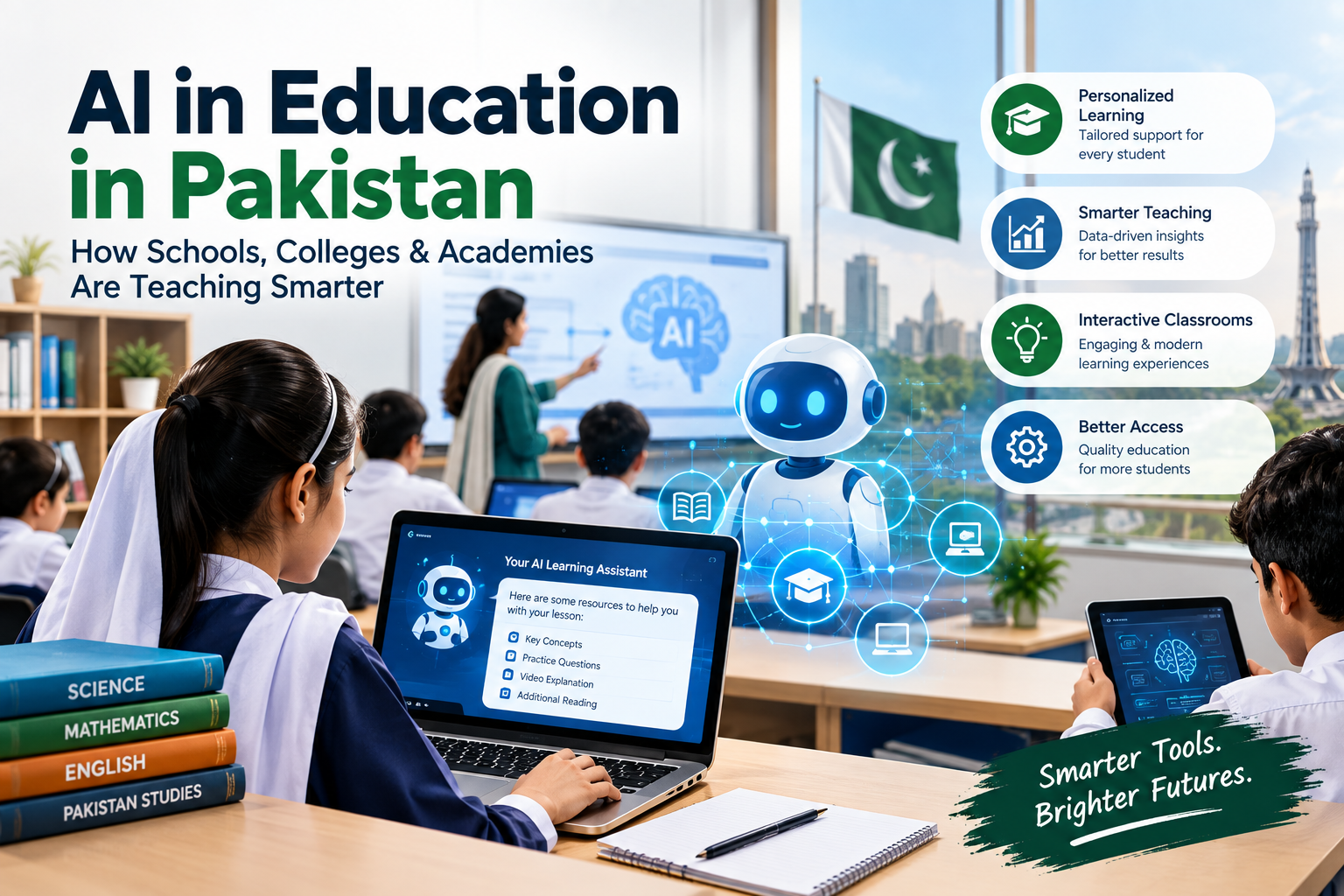
1. Why AI in Education Is the Next Big Shift for Pakistan
Every principal in Pakistan knows the same routine: attendance registers filled by hand, teachers manually totalling marks, exam results compiled in Excel for a week, parents queuing at the office to ask "beta ka result kya hai?", and fee reconciliation done at month-end from memory.
AI in education replaces that manual drag with systems that learn. It marks papers faster, spots students who are falling behind before the exams, personalises practice material for each child, and predicts which classes need more attention — all while the staff does its normal work.
Globally, the shift is well documented: the Stanford AI Index tracks education as one of the fastest-growing sectors for AI adoption, and studies by McKinsey's education practice show AI saving teachers hours of administrative time weekly. Pakistan's education market — thousands of private schools, colleges and academies — is at exactly the point where the first movers gain a lasting edge over institutions still running on registers.
2. The Daily Chaos Every Pakistani School Knows
- Attendance eats the morning. Calling 40 names aloud per class and re-entering them manually wastes teaching time daily — the exact problem a school management system in Karachi solves with AI-assisted attendance capture.
- Grading is a weekend-killer. A teacher with 5 sections × 40 students marks hundreds of papers. AI grading handles objective and structured questions instantly and flags handwriting or anomalies for review.
- Weak students are discovered too late. Without continuous tracking, a child who struggles in September is only noticed in the December exams. Predictive analytics flags at-risk students months earlier.
- Parent communication is reactive. "Why did my child miss school?" should be a notification, not an angry phone call at the office.
- Reports and results are manual chaos. Final grade sheets, board forms, fee reports — all compiled by hand, all prone to errors.
- One-size-fits-all homework. Every student gets the same practice set even though their gaps are different. Personalised learning changes that.
None of these are unsolvable — they are data problems, and data problems are exactly what AI is good at.
3. 7 Ways AI Is Transforming Schools & Academies
✅ 1. AI-Assisted Attendance & Smart Registers
Cameras, card readers or app-based check-ins feed attendance directly into the system. AI validates the data, alerts the office to anomalies (a student marked present in two classes at once, or absent for five straight days), and sends parents a WhatsApp or SMS notice automatically. No registers, no re-entry, no arguments at month-end.
📝 2. Automated Grading & Exam Analysis
Objective papers are graded instantly. For descriptive answers, AI proposes marks and highlights the parts a teacher should review. After each exam, the system auto-generates the class performance breakdown — average, top scorers, weak topics, question-wise difficulty — in minutes instead of days. This is the same intelligence foundation our exam and mark management modules are built on.
🎯 3. Personalised Practice & Adaptive Learning
AI builds a practice set from a student's error pattern: the child who keeps failing decimals gets decimals drills; the one acing algebra gets harder problems. Adaptive learning platforms do this per student, per subject — giving every child a curriculum that fits them, which is impossible for one teacher to do for 40 students manually.
📊 4. Predictive Analytics — Spotting At-Risk Students Early
By combining attendance patterns, assignment scores, class participation and behaviour flags, AI predicts which students are at risk of failing or dropping out — weeks or months before it happens. Counsellors and parents are alerted with specific, actionable guidance instead of a surprise result card.
🤖 5. AI Study Assistants & 24/7 Tutoring
Students submit a question and an AI assistant explains it step by step, in English or Urdu, at any hour. This is not replacing the teacher — it is extending the classroom to 10pm when parents cannot afford private tuition. Pakistan's students already learn from YouTube and WhatsApp; AI tutors meet them in the same channel, and our Urdu AI guide explains why language support matters for local students.
🗂️ 6. Smart Administration — Fees, Timetables & Reports
Fee reminders go out automatically, late-payment reports generate themselves, timetable conflicts are detected before they hit the notice board, and board/result forms are pre-filled from the database. The admin staff stops being data-entry operators and starts being managers. A modern school management system with AI layers handles all of it from one dashboard.
🎓 7. Career & Subject Guidance
AI analyses a student's strengths across subjects and suggests subject combinations and career paths — helping students and parents make informed decisions about FSc vs. ICS, pre-med vs. pre-engineering, or O-level vs. Matric, based on actual performance data rather than family tradition.
💡 The honest framing: AI in education does not replace the teacher's judgement — it removes the paperwork that steals the teacher's time, and it gives the school data to make better decisions for every child.
4. School Without AI vs. School With AI
| Activity | Traditional School | AI-Enhanced School |
|---|---|---|
| Morning attendance | 50 registers, 30 minutes | Automatic, instant, verified |
| Exam grading | Days of manual marking | Minutes + teacher review |
| Weak-student detection | After the result card | Months early, with a plan |
| Homework | Same set for everyone | Personalised per student |
| Parent updates | Phone calls & meetings | Automatic WhatsApp/SMS |
| Fee management | Month-end reconciliation | Auto reminders + live reports |
| Subject selection | Tradition & guesswork | Data-backed guidance |
| Staff workload | Overloaded with paperwork | Focused on teaching |
5. How to Start: A 5-Step Roadmap for Any Institution
- Digitise the core first. Attendance, marks, fees, timetable — if your school still runs on registers, the first step is a proper management system. Global Dezigns builds school management systems in Karachi and Pakistan with admin, student, parent and teacher portals, HRM, payroll, exams and reports — the foundation every AI layer needs.
- Use the data you already collect. Attendance and mark records are the training ground. Start with automated reports and grade analytics — zero new equipment, immediate visible benefit.
- Add AI-assisted grading and attendance next. These two save the most teacher time per week and are the easiest wins for staff buy-in.
- Layer in predictive and personalisation tools. At-risk alerts and adaptive practice bring the "wow" — and the measurable improvement in results parents notice.
- Train staff and measure. A one-hour session on the new workflow beats a 50-page manual. Review after one term: teacher hours saved, result improvements, parent satisfaction.
Need integration with existing systems or custom AI features? Global Dezigns also offers custom software development in Karachi — from a simple attendance module to a full AI-powered learning platform.
6. Frequently Asked Questions
Q1: Is AI in education affordable for a small private school?
Yes. Cloud-based school management systems with AI modules are priced per student or per school, and the time saved on attendance, grading and reports usually covers the subscription within a term. Start with the core system and add AI features as the budget allows.
Q2: Will AI replace teachers?
No. AI handles grading, data entry and repetitive administration — the parts teachers dislike. The teaching, mentoring and judgment remain human. Schools that use AI simply have teachers with more time to actually teach.
Q3: Does AI work with Urdu and local curriculum?
Yes. AI study assistants support Urdu and Roman Urdu alongside English, and the system handles Matric, FSc, O-level and A-level structures. See our Urdu language AI guide for the details.
Q4: How long does it take to implement?
A school management system typically goes live in 2–4 weeks including data migration. AI features like grading and analytics activate as soon as the first term's data is in the system — often 4–8 weeks of normal use.
Q5: What if my school is already using another software?
If the current system exports data, AI layers can often be added on top. If you are stuck on a legacy system with no export, switching to a modern platform is usually cheaper than trying to bolt intelligence onto old code — talk to a developer about migration before deciding.
Q6: Is student data safe with AI systems?
Data security depends on the setup. A reputable provider keeps student records encrypted, restricts access by role (the same dynamic permissions schools already use), and signs a data-processing agreement. Ask for these in writing before any vendor handles student data.
7. Conclusion
Pakistani schools do not need to wait for a tech revolution — the tools exist today, and they are built for local reality: Urdu support, Matric and board structures, WhatsApp parent communication, and budgets that a private school can actually afford. AI in education does not replace the teacher or the classroom; it removes the chaos around them, so teaching gets the time it deserves and every child gets attention before it is too late.
The schools that start now will be the ones parents talk about in five years. The ones that wait will be playing catch-up with a full term of lost time.
View All Blogs